
Research
Bird Flight and Navigation (Overview)

We use high-speed kinematics to track head, body, wing and tail movements during turning flight of pigeons and other birds to assess the aerodynamic forces acting to support the animal's weight and produce the moments (roll, yaw and pitch) about the bird's center of mass enabling it to change its heading during a turn. (Ros et al. PNAS, 2011)
High-speed kinematics also allows us to quantify the navigational path of pigeons during flight through an artificial 'forest' of vertical poles. Known locations of the poles in relation to the bird's heading and position through time allows us to model visual cues that guide the bird's maneuvering and enable robust flight past randomly distributed obstacles. (Lin et al. J. Roy. Soc. Interface, 2014)
Ruby-throated hummingbirds (Archilocus colubris) – similar to Anna’s hummingbirds – adopt two strategies to fly through tight spaces, such as the openings in a chain-link fence. Swept-wing transits involve retraction of the wings to reduce wingtip separation, as the hummingbird then ballistically glides through the opening. Sideways transits involve a rotation of the bird’s body to more perpendicular orientation to the fence, then continuous but reduced amplitude wing flapping and slower transit velocity compared with swept wing transits.
See Zhang, Z. M., Konow, N. and Biewener, A. A. (2025). Hummingbirds excel at maneuvering and flying through tight spaces. J. Exp. Biol. v.228, jeb250269. https://doi.org:10.1242/jeb.250269 for the details!
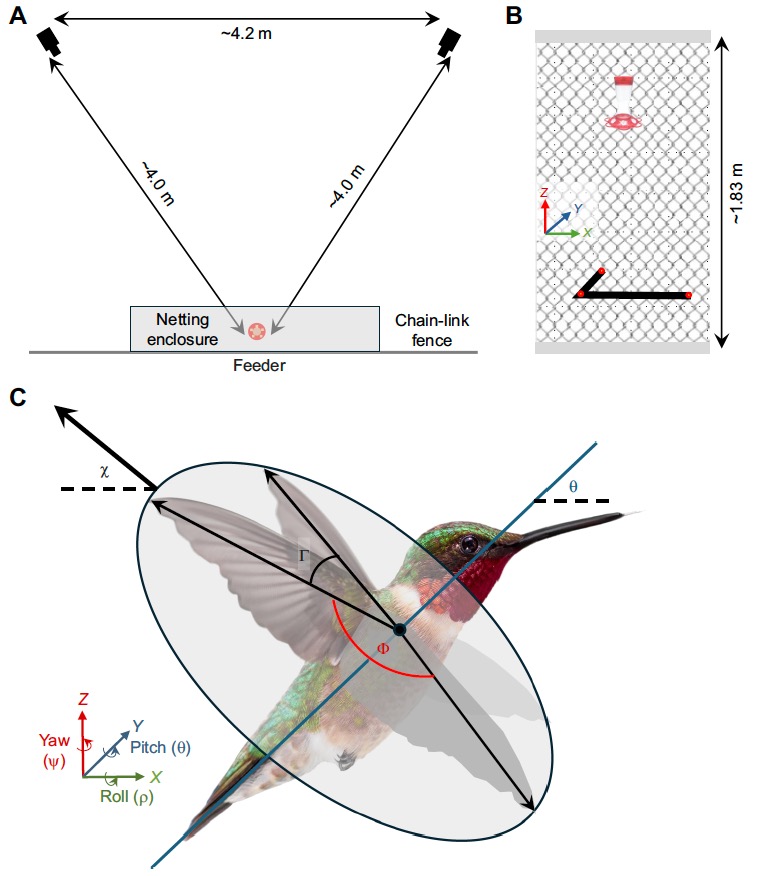
Experimental Setup. We recorded wild ruby-throated hummingbirds as they approached a feeder by flying through a chain-link fence to access the feeder, with high-speed camera situated as above. Anatomic variables of hummingbird wing and body motion.

Wingspan and angle between the wings( Γ) differ in relation to transit strategy, showing distinct differences in pattern associated with the interrupted flapping (gray shading) during swept-wing transits versus continuous flapping of sideways transits (pink shading -slower flight and longer transit duration of sideways transits, B & D). Wingspan oscillates between maxima at each mid-downstroke and mid-upstroke versus minima at the end of each downstroke and upstroke. Sideways transits involve overall decreases in wing stroke amplitude and wingspan.
Muscle Function and Recruitment (Overview)


| 
|
Our work on muscle function focuses on methods for recording contractile patterns of muscles in vivo with the goal of evaluating time-varying properties of muscle force and length change in relation to neuromuscular activation. In vivo recordings are based on tendon-buckle force (Biewener et al. JEB 1998; Daley & Biewener, JEB 2003) or bone strain measurements (Dial, Biewener et al., Nature 1997; Tobalske et al. Nature 2003) combined with sonomicrometry (fascicle length change) and EMG, and are integrated with muscle force and joint moment requirements based on inverse dynamics and whole-body center of mass movements (Daley et al. JEB 2007; Arnold et al. JEB 2013). Measurements of muscle function and recruitment patterns (based on EMG intensity and spectral frequency components derived from wavelet analysis) are also combined with musculoskeletal modeling to develop and evaluate Hill-type muscles models, often employed in studies of human movement, motor control and rehabilitation. Above are recordings from a tammar wallaby during hopping (Biewener et al. JEB 1998) and below from a cockatiel during flight (Tobalske et al. Nature 2003).
